Corona
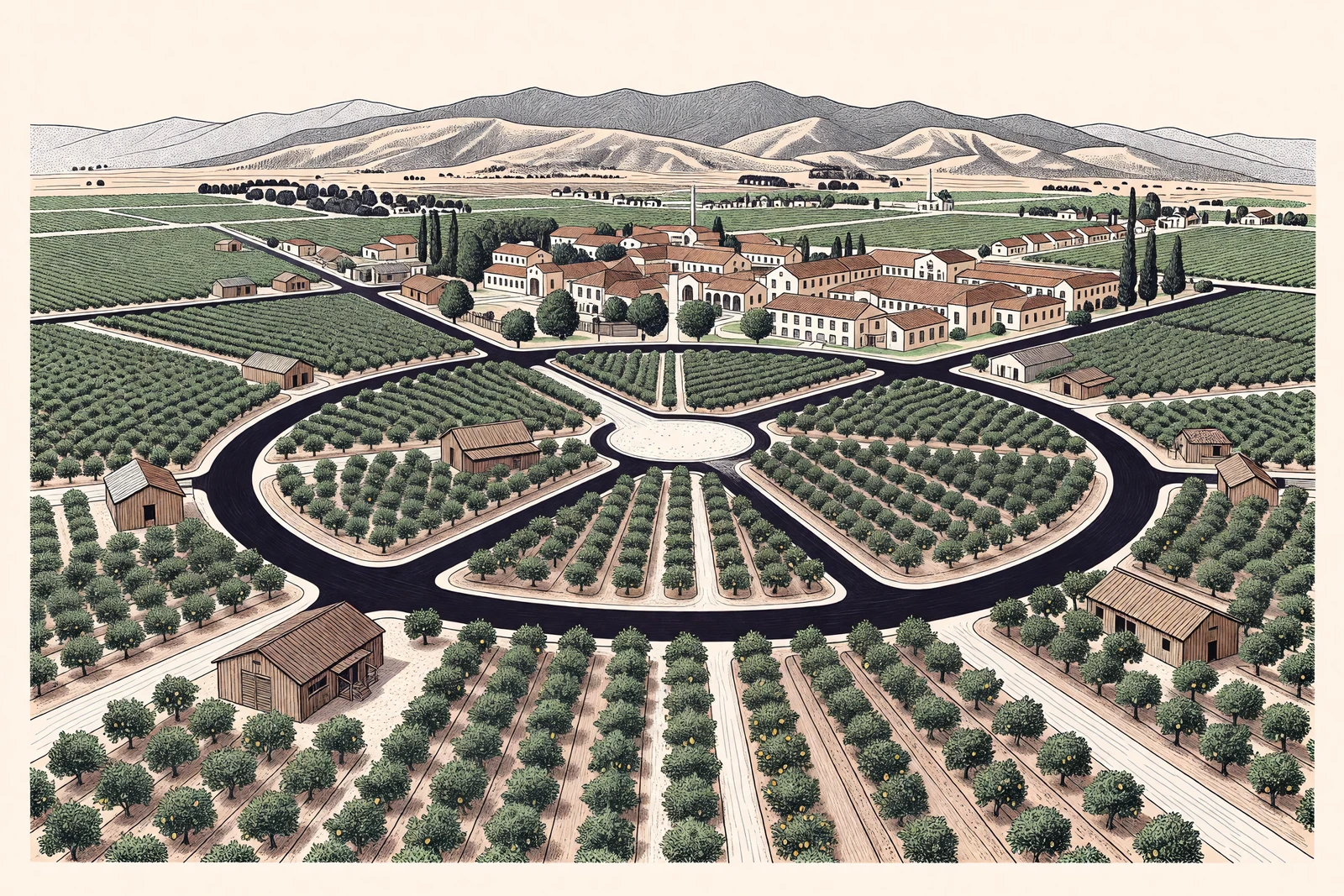
The town of Corona, California was a small agricultural community in 1944. The town was surrounded by citrus groves and there were several citrus packing sheds in the area. Also a crew of research scientists were working to develop frozen lemon concentrate for the food industry. This plant was a cooperative owned by a number of large citrus growers. Among the owners were the Jamison family who really represented the economic and political power in the town at that time and who also controlled the water supply used to irrigate the vast citrus groves. It was the general feeling among the citrus growers that their success depended in large part on low priced labor.
Corona had grown up around a one mile race track and the old brick track was called "Grand Boulevard." It was a perfect circle and the town's main claim to fame was that Barney Oldfield had raced on the track in 1910.
With one exception, California school districts are separate political entities and have no relationship to cities except in name. San Francisco is the exception and is a county, a city and a school district all in one. In Corona the city consisted of three or four square miles while the school district covered two hundred sixty seven square miles. It included Home Gardens, Eastvale, Norco, Temescal Canyon and areas far up on the mountain range south of the town of Corona.
Our first big problem when we arrived in Corona was finding a place to live. The Norconian Hotel and resort had been converted to a hospital for Navy personnel. Their families and dependents occupied nearly all the available rental space in the area. We first put our furniture in storage and went to a small hotel while we searched for a place to rent. When nothing turned up after a week or so Guin and Carol went to Phoenix to stay with Grandpa and Grandma Robinson. I "batched."
I started football practice at the high school and "advertised" the housing problem among the ball players. They came up with a number of suggestions but none of them worked out. Finally, one of the high school teachers told me that he had an apartment that we could rent so I took it and called Guin and Carol. At least we had a place to live for awhile.
Corona High School had about four hundred students when I taught there and I estimate that about half of them were of Mexican descent so a good percentage of the football squad was Mexican. These boys were from the low priced labor families so necessary to the citrus industry.
I had an immediate problem because I had never coached eleven man football. At Patagonia we had played six man. At the time Stanford University was the dominant college football power and they used the T Formation so that is what I started with. After the first game I realized that we just did not have a quarterback who could handle the T Formation so I suddenly switched to the Single Wing. We won a few games but really did not do well in football my first year and it was my fault.
In basketball I had more experience both as a player and as a coach so we won the league championship my first year. Luckily I hit on the idea of using a combination man-to-man and zone defense. It was quite simple to teach and confused our opponents no end. I had to laugh years later when John Wooden at UCLA used essentially the same system to win three consecutive national championships. All we did was play man-to-man until the ball got to a certain point on the court, then switch to a zone.
We lived in the Bynum apartment the first year at Corona and in May we purchased a small house in Norco. It was located on one and a quarter acres and cost us thirty five hundred dollars. That was rather a large amount since our salary was about two thousand dollars per year.
Meanwhile, I was not fully certificated to teach in California and needed to earn more college credits. So the first summer Guin and Carol went to Young to stay with Grandpa and Grandma Waldrip on the ranch while I attended the University of Arizona in Tucson. I began work on a Masters Degree that summer and this effort continued until 1952 when I finally earned the Degree at Claremont College near Pomona. This effort was rather taxing for me and Guin since I worked at other jobs also. I coached all major sports after school, taught Adult School two nights a week and held a special class once a week for boys who had dropped out of school. To say the least, it was a busy schedule.
It was difficult to find teachers at that time and almost impossible to get a shop teacher. Corona High School had a fairly good automobile shop and welding facility but had no adequate teacher for those courses. I made a deal with the Principal that I would teach the shop classes if he would get some one to teach Physical Education and help with coaching major sports. We were able to get a good man and so I got some help with coaching and also got some experience in auto shop and welding.
I think the teaching staff at Corona was quite good but each teacher was paid whatever amount he or she could force the Board to pay. There was no over-all salary policy. I became active in the teacher's organization and was asked to serve as Chairman of the Salary Committee. I attended training sessions at the California Teacher's Association headquarters in Los Angeles and learned something about salary schedules, tax measures and school district budgets. When spring came and we met with the School Board, I presented them with a complete District Budget which showed that the Board could give all employees nine percent raises without causing the district any financial problem. That really marked the beginning of my career in school business management because a month later when the Business Manager resigned I applied for the position and became Assistant Superintendent-Business at Corona Union High School and Corona Elementary School Districts. I had been in the system three less than three years and was not regularly certificated but was now second only to the top man, the Superintendent. Some of my fellow teachers were a bit envious but that was only a minor problem.
I was taking School Business and School Administration courses at Claremont College some twenty miles from Corona. I went to class each Saturday and sometimes at night during the week. It was necessary to get teaching credentials first and then get the administration credentials. I got all of those while going part time and working full time.
Business management in public school districts was a new and unique field in the nineteen forties. Only large districts hired Business Managers at the time but with the increase in school age children and the increasing complexity of school finance most districts began to hire administrators to handle the areas of budgets, accounting, building maintenance and operation, pupil transportation, purchasing, food service, insurance and salary negotiations. When I became Assistant Superintendent in Corona, we had two districts, the elementary and the high school. There were two budgets to be administered and there were two school boards to work with. The high school board had five members and three of them were the elementary board. Part of my salary and that of all central office employees was paid by each district. All accounts and records were kept separate. That sounds complicated and it was because both boards met on the same evening and only three of them could legally transact elementary district business. We constantly had to remind board members that only three specific people were the elementary board. Later I simplified the whole process by getting the district "unified."
When I became Business Manager I became faced with a number of specific problems that I thought needed immediate attention. First, the attendance boundaries between the elementary schools were so "gerry mandered" as to create a segregated Mexican school. This had been done deliberately. Second, the district was being ripped off by a pupil transportation contractor whose family was a political power in the community. Third, all books and records were kept by hand and it was almost impossible to tell what was going on and where we were financially.
I decided to tackle the records problem first and I happened to be talking to a local banker at a Lions Club meeting about our situation. He informed me that the bank had recently purchased a National Cash Register bookkeeping machine and that now they were able to total the day's business one hour after closing rather than at nine o'clock in the evening. I called National Cash Register and they came immediately and showed me the systems being used by a few other school districts. I knew these systems would solve our problem but I had more bases to touch. The County Superintendent of Schools did not travel by horse and buggy but it would have been most appropriate for him to do so. He audited every expenditure of every school district in Riverside County. He wrote and signed each check for every district except Riverside City Schools and he did not consider Corona capable of keeping its own records. In other words he turned down the idea of the bookkeeping machine. I was some what frustrated and decided to talk with the County Auditor, Ray Hicks who did the final check on all expenditures made from the County Treasury. As I had suspected, Hicks was very critical of the County Superintendent's record keeping and immediately endorsed the proposal I had made to upgrade the system. We went together to see Mr. Smith, County Superintendent of Schools, and Hicks told him that he was tired of trying to make sense of all his messy records and accounts and it was time to modernize the system. He added, "Further more, if you do not approve this improvement, I will go to the Board of Supervisors and lodge a complaint about the current system." I suppose Mr. Smith felt rather uncertain about his position because he agreed to accept my proposal and to cooperate in getting it started. At any rate, we began to write and sign our own checks and the charges were distributed automatically to each budget category as the checks were written on a bookkeeping machine. We were able to present an accurate financial report each month and to project costs and balances to the end of the fiscal year. These are minimum reports for responsible fiscal management.
I should tell you something about Frank Bishop, the Corona Superintendent of Schools who had been in that position since 1934. Frank was a scholarly man and was very well liked by all those who worked with him. The Board members trusted Frank's good judgement and relied on him for advice in all school matters. Most of the residents of the school district were friends of Frank's but there were more and more who became impatient over unsolved problems. Frank was very astute and knew his time as Superintendent was limited so when I became Assistant, Frank told me that I was to run the District while he attended UCLA to get his Doctors Degree. He said he would be home each evening and would be available for consultation in case I needed his advice. I was to hire employees, instruct principals, prepare for Board meetings and do all the things necessary to operate the District while he took an unofficial "Sabbatical Leave." The School Board, of course, had approved this arrangement and to be fair Frank had taken no vacation of any length for over ten years.
As I mentioned before, the pupil transportation contractor was not providing acceptable service and had a long term contract. Because of his family connections and because there was no other contractor to take his place, I did not want to attempt to void his contract. I discussed the matter with Frank and the Board members and came up with the idea that we could purchase the contractor's vehicles and operate them ourselves with our own employees. This idea sounded good and the only problem was with getting enough money to make the purchase. It was obvious that we would need to hold a special tax election to raise the money but this discussion led to some other funding needs that I will attempt to explain.
I have previously mentioned the "fake" attendance boundaries that placed all Mexican pupils in one elementary school . I was determined to get rid of that eyesore and while I was considering various options, a rather large earthquake occurred. I rushed down to the Mexican school and,sure enough, the stucco on one side of the building had come loose and there was a very distinct bulge in the west wall. I managed to get a very excitable local reporter to come to the school. I got a very long straight edge and held it against the wall to show the extent of the bulge while the reporter took pictures. Those pictures in the local paper got the whole community excited and certainly excited the Board.
In California the structural requirements of school buildings are extremely high so when the Board called for a structural review of all elementary schools I knew we were in real trouble because none of the schools would pass inspection and we did not have the money to replace them. Sure enough, we had three whole schools condemned including the Mexican school which was my original target.
Under California law, when a school building is condemned, the Board Members are personally liable if a student is injured in that building so we were in a very precarious spot with three condemned school plants. We decided to take a chance on using two of the schools. In the case of Norco, we negotiated with the Navy and were able to use a building at the Naval Hospital.
I was aware that local school districts were eligible for State assistance if they were bonded to capacity and still could not house their pupils. When I estimated the cost of three new elementary schools and checked our bonding capacity, I saw that by voting a new bond issue we would reach our bonding capacity and would still be unable to house our pupils. This situation would make us eligible for a State grant.
Again I sat down with Frank Bishop and outlined a finance program that would do a number of things. It would get us three new elementary schools, purchase the school bus fleet, give substantial raises to school employees and provide some needed improvements at the high school and junior high. All we would need to do was to pass a bond issue at the elementary level, a bond issue at the high school, a tax override at the elementary level and a tax override at the high school. In addition, we needed approval from the voters to accept state assistance to build three new elementary schools.
Only an idiot would try to get voter approval of all those propositions at once but I thought each one was important and would stand on its own. I convinced the Board and the Superintendent that we should schedule an election in both districts and put the bond and tax propositions up to the voters. After all, we might get lucky and pass the whole outfit. They agreed and placed the item on the agenda for the next Board meeting for action.
Early the next day, I received a call from Joy Jamison and he wanted to talk with me in his office. I agreed to be there at ten o'clock. Mr Jamison was a major citrus grower and was head of the cooperative that owned Lemon Exchange Products. When I arrived at his office he was most cordial. We had a cup of coffee and he told me how efficiently the schools had operated long before I ever arrived on the scene. He told me that the tax rate for schools was high enough at its present level and that he was opposed to a special election which he had heard was being planned. I thanked him for his words of wisdom and for the coffee and then went on my way. I never heard from him again but obviously the Board and Superintendent had been under his control for many years.
I do not want to give the impression that nothing was going on in the school district before I became Assistant Superintendent. On the contrary, a new Junior High School was under construction and an elementary school was out for bid when I came in the office. The architect on these two projects was G. Stanley Wilson who had designed the Mission Inn in Riverside and who had a "Continuing Contract" with the school district. This meant that he would do all the architectural work for the district. Mr. Wilson did not have a good reputation as a school architect. His designs were far too ostentatious for schools and after the Board had called for our special election, it became apparent that our chances of success would be far greater if we did not use him. It fell my lot to terminate Mr. Wilson and I did it immediately. The two of us worked out a settlement for work he had already done and he was most understanding of our problem.
I knew that we would have to explain to the voters all the ballot propositions but I was not sure just how to go about it. I discussed the matter with the high school Journalism teacher and he informed me that his classes were going to take over the local paper in celebration of the Fiftieth Anniversary of Corona High School. This event would take place about two weeks before the bond and tax election. The students were to sell advertising, furnish pictures and provide all the copy for two issues of the local paper. I provided the students with full information about the bond and tax propositions and they did a most enthusiastic job of writing news stories about them. There were plenty of graphs, charts and pictures. Merchants who bought advertising in the paper to congratulate the high school on its fiftieth anniversary appeared to be endorsing the tax and bond issues because those issues were the main theme of the paper. We had full community support for all the ballot measures and expected all of them to receive the required two thirds approval necessary to carry.
Meanwhile, I had been reading the California School Code which is the "Legal Bible" for all public school districts. I found a section of the law that involved "Unification of Districts." The section said that, "When the boundaries of an elementary district and a high school district are coterminous except for a small elementary district and when the school building in that small elementary district is three miles or less from the nearest elementary school in the adjoining district, the County Board of Supervisors may, on the recommendation of the County Superintendent of Schools, declare that a Unified District exists and may combine the districts." In the case of Corona, the elementary and high school districts were coterminous except for Eastvale Elementary which was in the high school district but not in the elementary. An employee and I took a surveyors chain and measured the distance from Norco School to Eastvale School and found it to be forty five feet less than three miles.
I went immediately to the County Superintendent of Schools and told him of the situation. He wanted to get rid of Eastvale because they had given him a lot of trouble in the past and it was difficult to keep teachers there. We both came to the conclusion that Corona would be helped and that Eastvale would receive more adequate supervision if they were combined to make a Unified District. His recommendation was made and the County Board of Supervisors approved the matter. As of July 1 1948, Corona was scheduled to become a Unified School District.
Then I began to worry. We were going to vote on school bond issues and tax increases in the elementary and the high school. Could these bonds be sold by the new unified district? Would the tax increases which were voted in separate districts be valid in a new single district? I needed to find out in a hurry so I called O'Melveny and Myers, a Los Angeles law firm that rules on the validity of all school bonds in California. I posed the question to them and followed up with a letter so I would have a written conformation of their opinion. I was relieved to find that everything was going to be OK as scheduled. All assets of the original districts would become assets of the newly formed Unified District.
No further problems came up and all the propositions carried with a healthy majority. Now we had to get busy with an application for State Building Assistance and begin planning for three new elementary schools.
During this whole flurry of activity I could not spend much time with Carol and Guin who were keeping the home fires burning. I would come home late at night and leave early the next morning. They provided a sheltered spot where I could find a quiet peace that really was the help required for me to keep going. Only those who have lived through the turmoil of political strife can appreciate the healing quality of a quiet, clean, loving home.
The Architect and I were struggling with the applications for State School Building Assistance since that aid would be required to build three new elementary schools. It would also require some bond funds that had just been voted. We had just finished all the paperwork on the applications when I got a call from Guin. Carol had fallen from the top of a picket fence and was injured. It was necessary to take her to the hospital in Riverside for X rays of her leg. This we did and, sure enough, she had a cracked bone in her leg. She stayed in the hospital to have the leg set and a cast put on it. Guin stayed with her and during the night Guin became ill. I managed to get her to a doctor and get them both back home but it took some help from a good baby sitter. I then drove to Indio to get signatures from the President of the School Board on the State Assistance applications. When I got back home Guin's doctor had called and told her that she should have surgery immediately. We had been trying to have another baby and it was just not working out. The doctor thought that there was a problem with at least one ovary so we opted to go for surgery immediately while Carol was in a cast and the baby sitter would be able to keep up with her. Guin went to the hospital and I flew to Sacramento with the Building Assistance Applications while Carol stayed with a baby sitter.
I made some important contacts in Sacramento in the State Department of Finance, Local Allocation Division and in the Senate. The applications were accepted and it was a matter of waiting for action by the Allocation Board. No one was certain that the State Fund would have enough money to authorize Corona's building projects. We were just hoping that some of the applicants in line ahead of us would drop out or not be eligible. James Harris and Paul Hoyenga, who processed our application, indicated that they thought we had a good chance to get the money.
I went back to Corona and after a few days brought Guin home from the hospital. She had one ovary removed and the other one repaired. The doctor thought we had some chance of having another baby.
After waiting for two weeks for word from Sacramento, I called our State Senator who lived in Hemet. Sen. Dilworth was a real power in Sacramento since he had been serving there for twenty five years. He called the State Allocation Board and was told that Corona's application was scheduled for action the next week. I flew to Sacramento again and after much debate and arguing the Allocation Board approved all three of our projects.
While the building projects were being approved there was a school board election to select a new Board for the new Corona Unified School District. Five members were to be elected and none of the existing members were candidates. This meant that we would have a brand new Board of Education and most of the candidates were saying that they would bring in a new superintendent if they were elected. This put a great deal of pressure on Frank Bishop the current Superintendent. Five reasonably good candidates were elected and were scheduled to take office on July first. Meanwhile the old Board and Superintendent carried on with business as usual. Finally July came and at the first meeting the number one item on the agenda was the Superintendent's contract. Frank Bishop asked for permission to speak and simply announced that he would not be available to serve as superintendent since he had accepted a position as a professor at Redlands University. This action left the new board speechless and we proceeded with routine business. After the meeting I discussed the matter of getting a new superintendent and the Board asked me to contact a number of Universities to get applicants. I was to screen the applicants down to four or five who would be interviewed by the Board for a final selection. The process worked well and at the end, George Kibby was chosen from a group of five qualified applicants.
Kibby was a veteran school administrator who had served at Needles and at Redlands. He caught up very quickly with the Corona situation and was most helpful in all areas. Kibby recognized immediately that the sites on which we were scheduled to build new schools were entirely too small. They were all less than three acres and would simply not accommodate four or five hundred pupils. I had recognized this problem but was hesitant to go for more than was absolutely necessary. I thought it was better to have a half loaf than no loaf at all.
I quickly found some new sites in good locations and determined that they could be purchased. I got estimates of cost for each. Kibby and I went to Sacramento and had a session with Jim Harris and Paul Hoyenga of the Allocation Board. They asked us to get the recommendation of the State Department of Education and that was easy since George Kibby's father was a key administrator there. We got written approval of our Amended Application and went back to Allocation where they agreed to take the proposition to the Allocation Board at its next meeting. After much wrangling and nit picking we got the funds to buy three new sites and build three new schools. We also drew new attendance boundaries that did away with the grouping of Mexicans in one school. Our new schools would be racially integrated long before the remainder of the country was forced to go through that process.
Here I want to throw in some thoughts about the organization of schools in this country. after thirty years of work in school administration, I have come to the conclusion that local school boards are flat failures in handling school affairs. Those boards are mainly composed of small-time, tin-horn politicians whose primary aims are to build their own egos and to gain personal political power. In thirty years I worked with only three boards whose primary aims were the education of the pupils under their control. All the others were self-serving small-minded people whose interests were mainly personal and not aimed at the educational well being of school pupils. Let me temper those statements just a little. There were some very fine individual board members in my experience but nearly all boards were controlled by a majority who could not have cared less about the students in the schools. I doubt that the situation today is any different than it was when I retired in 1976.
I have related how George Kibby was chosen from five qualified applicants by the Corona Board of Education and noted that he was an experienced administrator. After he was on the job for six months, the Board Members began to criticize George about small things. Those criticisms were voiced to me, not to George. At a Board meeting, when George was absent, the members began a litany of complaints about him. I stopped them abruptly. I told them that they were "chicken" and if they had criticism of George they should make it to him not to me. I also told them that if they did their jobs as well as George did his we would have a wonderful district. That "lecture" was entirely too strong and I bent some noses that never got straight as long as I was in Corona. I knew it was a mistake as soon as I did it. I found out right there that erasers do not work on spoken words. Once they are said they echo for a long time.
On the home front things were looking up. Carol was in school and Guin was pregnant with Kay. We had sold the Norco property and were living in the Ballard house on Grand Blvd. I was still working on my Master's Degree at Claremont when Kay was born on December 3, 1951. She was a real joy and a hand full for all of us as she went through all the childhood illnesses one after the other. Carol was her champion and they were very close even though Carol was ten years older.
My salary at that time was not all that great being around four thousand dollars per year. I did extra jobs where ever possible. I worked during a month of earned vacation for Pacific Airmotive in Chino where we repaired airplanes that had supplied Berlin during the Russian blockade of that city. My experience with motor and flight controls at Douglas stood me in good stead . We used the money I earned at Pacific Airmotive to pay for Kay's "delivery" costs. It is a darn shame that she now hates to fly considering her "birth costs" came from an air craft repair company.
Although my relationship with Board Members was outwardly cordial I knew their resentment of me was still simmering underneath so I told them that as soon as I could find a suitable position I would leave Corona. I must give them credit for being patient because it was April of 1953 before I was able to find an acceptable position and submit my resignation to the Board. I hated to leave Corona where we had so many good friends but the petty attitude of the Board was intolerable. The Board subsequently hired a yacht broker from San Diego to take my place as Business Manager. They stated that they wanted a "Business Man" in that job. I went back after July 1 and helped develop a budget for 1953-54 but the Business Manager did not last long in that position and I suspect the Board did not give him a chance to succeed before they began to chew on him.
This part of this paper appears to be the appropriate place to comment about the County Assessor's impact on tax supported entities. The Assessor's duty is to establish the value of real property for tax purposes in accordance with State Law. Since there is a great variety of properties in each county and since the valuation of each property establishes the amount of tax an owner will pay, there is constant pressure by owners on Assessors to keep their values low. In Riverside County the Assessor always yielded to pressure from citrus growers and kept values of citrus groves at an unrealistically low level. A family could prosper greatly if they owned fifteen acres of lemon trees and they paid virtually no property taxes. Other kinds of property supported the local infra-structure and that property was mostly residential lots and houses. This situation resulted in Corona School District being "very poor" when in fact Corona was a very wealthy district and perfectly able to pay its own way but for the actions of the Assessor who gave in to the pressure from citrus growers. The State of California soon corrected this problem by establishing criteria for setting the value of various properties and then monitoring each county to make sure the procedures were being followed.
Lesser jurisdictions complain about their loss of authority to larger ones but when they cheat in carrying out their duties, they deserve to lose authority. If County Assessors did an honest job of establishing property values, the state would have no reason to check up on them.