A Wagon Trip
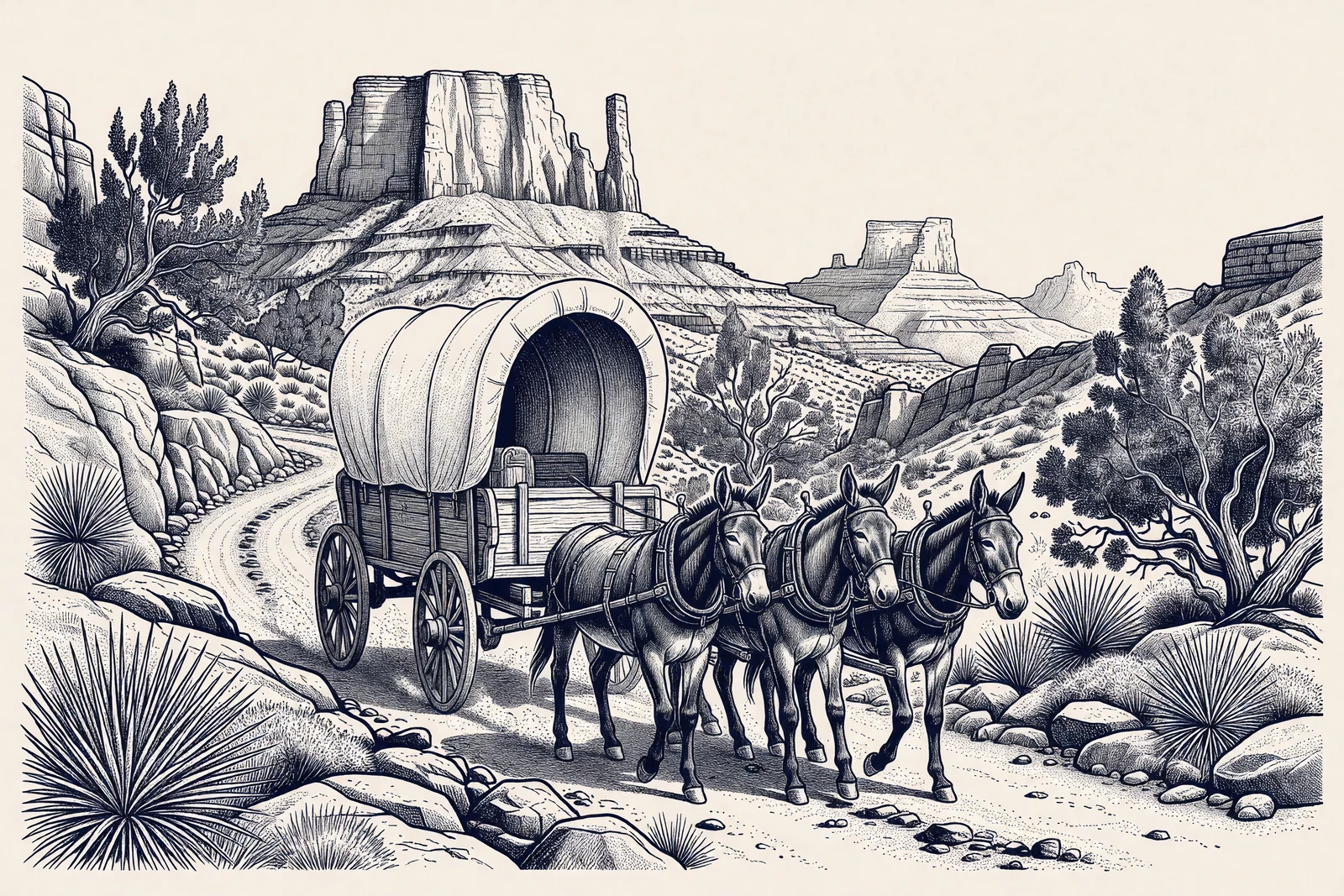
While we were living in Cloudcroft our cattle were on winter range in the desert south of Alamogordo. It was not difficult to get them to a railroad when we got ready to go. Finally we began to get ready in a serious way. Ruth had been born and Mother felt well enough to make the trip. I am sure she considered it to be more than a slight matter but on the surface she was calm and equal to any challenge she had to face. She was anxious to get Dad to a climate recommended by his doctor.
Dad was so enthusiastic about Pleasant Valley that other relatives decided to join our train. They were Dad's sister Effie and her husband John Martin, Mother's brother Bodie Davis and his wife Nellie, Dad's youngest brother Anderson Waldrip and Mother's brother Dalton Davis. We had two wagons and the Martins and Davises had one each. We had six horses; Maude, Snip, Fox, Tony, Red and Roan. Dalton owned Roan.
By February every one was ready. Dad loaded the cattle on the train and began his journey to Globe, the nearest rail head to Pleasant Valley eighty five miles away with the world's roughest roads in between. When Dad arrived in Globe, he had no horse so he went to the owner of a livery stable in an attempt to buy one. The owner said he had an outlaw horse that Dad could have at no charge if he could ride him. Dad had no trouble riding the horse so that is the way we acquired Brownie. Floyd and I rode him to school later and he threw us off only once which was not bad for an "outlaw." Dad herded the cattle out east of Globe in the area near El Capitan while waiting for us to catch up.
Back at Cloudcroft, we loaded the wagons and took off for Arizona. Now I don't remember this trip being a "big deal." It just seemed to be the thing to do. Dad needed to be at a lower altitude so we simply were moving to a place that would help Dad and where there was pasture for our cattle. No problem. I know now that Mom set this idea in our minds to keep us from fretting about the move. We would certainly miss Grandma and Grandpa but we knew we could have a visit once in awhile.
The beginning of the trip is a bit hazy in my memory. Floyd and I would ride in a wagon for awhile and then walk until we were tired then ride again. Mother drove one wagon behind Maude and Snip. Uncle Dalton drove the other behind Red and Roan. Ruth was about one month old, Victor was four years, I was eight and Floyd was eleven. I recall the camp in Oregon Pass just east of Las Cruces. It was freezing weather and the wind was blowing a gale all night. Mother, Ruth, Victor and I slept in the wagon which had a canvas cover. Floyd, Dalton and Anderson slept on the ground under the wagon. Mother and I were up all night trying to stay warm and trying to keep the canvas cover from blowing off. Floyd, Dalton and Anderson slept right through the whole thing. They didn't even know the wind blew.
I remember when we crossed the Gila River near Safford because I had a new cloth hat and it blew off and floated away down the river. In San Carlos, some young Indians tried to drive our horses away but caused no problem when we challenged them.
After about two weeks on the road we reached El Capitan and joined Dad. We rested there for awhile and Floyd and I enjoyed riding on an ore truck driven by our Uncle Duck Sorrells who was married to Dad's youngest sister, Edna. One would think there was a lot of automobile traffic on the roads in those days but there was not. I cannot remember having any problem with cars on the road on that whole trip and we were on major roads at all times.
We and the horses were well rested when we left El Capitan on our way to the "Valley." The cattle were driven along in or near the road as we traveled toward Salt River. I recall the camp at Hicks Wash the first night out from Globe. There was nothing remarkable about it except it just seemed to be a wonderful place to camp over night.
Crossing Salt River and Roosevelt are unforgettable. The river was in flood from rain and melting snow so we waited a few days for it to go down. Finally we decided to cross the cattle at a point above the lake. We had the help of a local rancher named Hoyt Medlar who rode a little mule that could swim like a duck. Floyd, Dalton, Medlar and Dad drove the cattle into the river. Dalton and Floyd were on the upstream side. Dad and Medlar were on the downstream. Dad was riding Fox and somehow he went over a riffle into very deep water. Both horse and rider disappeared under water. It seemed as though they were under for a half hour as we watched from the bank. Finally Fox's head appeared, then the saddle was visible and at long last Dad bobbed up. He had slipped off the saddle and grabbed Fox by the tail in an effort to help him in the deep water. I saw Mom brush a tear off her cheek as Fox and Dad waded out on the other side.
Floyd and Dalton took charge of the cattle and Dad came back to the south side to help us get the wagons across. This involved going downstream some five miles to a ferry boat landing where the teams and Fox were placed aboard a strange craft to be ferried across about three miles of wind swept water. The wind had been blowing all day and there was quite a swell running on the lake. We stayed in the wagons as they were driven aboard. The horses were unhooked and placed beside the wagons. There was some discussion about waiting for the wind to die down but with Floyd and Dalton on the other side we felt that we needed to be over there. The boat was a square contraption made of heavy timbers and was propelled by a Model T engine mounted on the side. The engine was reluctant to start but finally got going. The floor of the boat was covered with water and I remember watching the waves go from one end to the other as we went across.
We finally made it to shore and joined Floyd and Dalton who had driven the cattle down to the north landing. That old ferry boat was a real experience. A few years later Dad and I crossed there with a team and wagon. We got on board, unhooked the team and I was holding them beside the wagon. The team was Red and Roan. Again the engine was difficult to start and by the time the "Captain" got it going we had drifted some distance from the shore. When the engine finally started it back fired with a loud noise and startled Roan. He took off over the side and almost took me with him. He had on a heavy chain harness and we knew he could not swim with it on. We waited what seemed like a half hour and finally Roan came wading out at the boarding ramp blowing water out of his nose. The heavy chain harness held him down and allowed him to wade out on the bottom. With out it he would have drowned.
Back to the wagon trip. I remember only two more camps on the trip to the Valley. The first one was a point of rock that had vertical cliffs on all sides except one. We drove the cattle out on the point and then camped right in the narrow entrance so we had them fenced in and had a great view of the area to the south. The second camp was just seven miles from the Valley and it was called Seven Mile Saddle. There we broke a wagon wheel. We left the broken down wagon there and returned for it a week later using a wheel from the wagon that made it all the way carrying its own load plus most of the load from the one left behind.
I am going to leave the wagon trip now with a few more notes. You will remember we started the wagon trip with Bodie and Nellie Davis. They turned back to Alamogordo at or near Lordsburg. John and Effie Martin got all the way to Globe and then turned back to Alamogordo. Anderson left us at Globe and went to Winkleman where his father was living at the time. Dalton Davis stayed with us and lived in Pleasant Valley for many years.