Young (Pleasant Valley) Arizona
April 17, 1920 was an extremely cold and windy day. It was also the day on which the Waldrip Family and Dalton Davis entered Pleasant Valley or, Young as the U. S. Post Office called it. They were driving one wagon. They had seven head of horses, one hundred head of white face cattle plus the calves born on the trip and four children including a two month old baby.
What kind of a place had they come to? To tell the truth, it was not very imposing. We had entered the valley through a rocky steep canyon that cuts into the north slope of the Sierra Ancha Mountains. The whole surrounding area was wrapped in drab winter colors and seemed dark and lifeless. We could see a few houses scattered about where smoke was coming from the chimney. There were a few horses and cattle in pastures but no people were in sight,. It was rather a lonely feeling to think "this is to be our home."
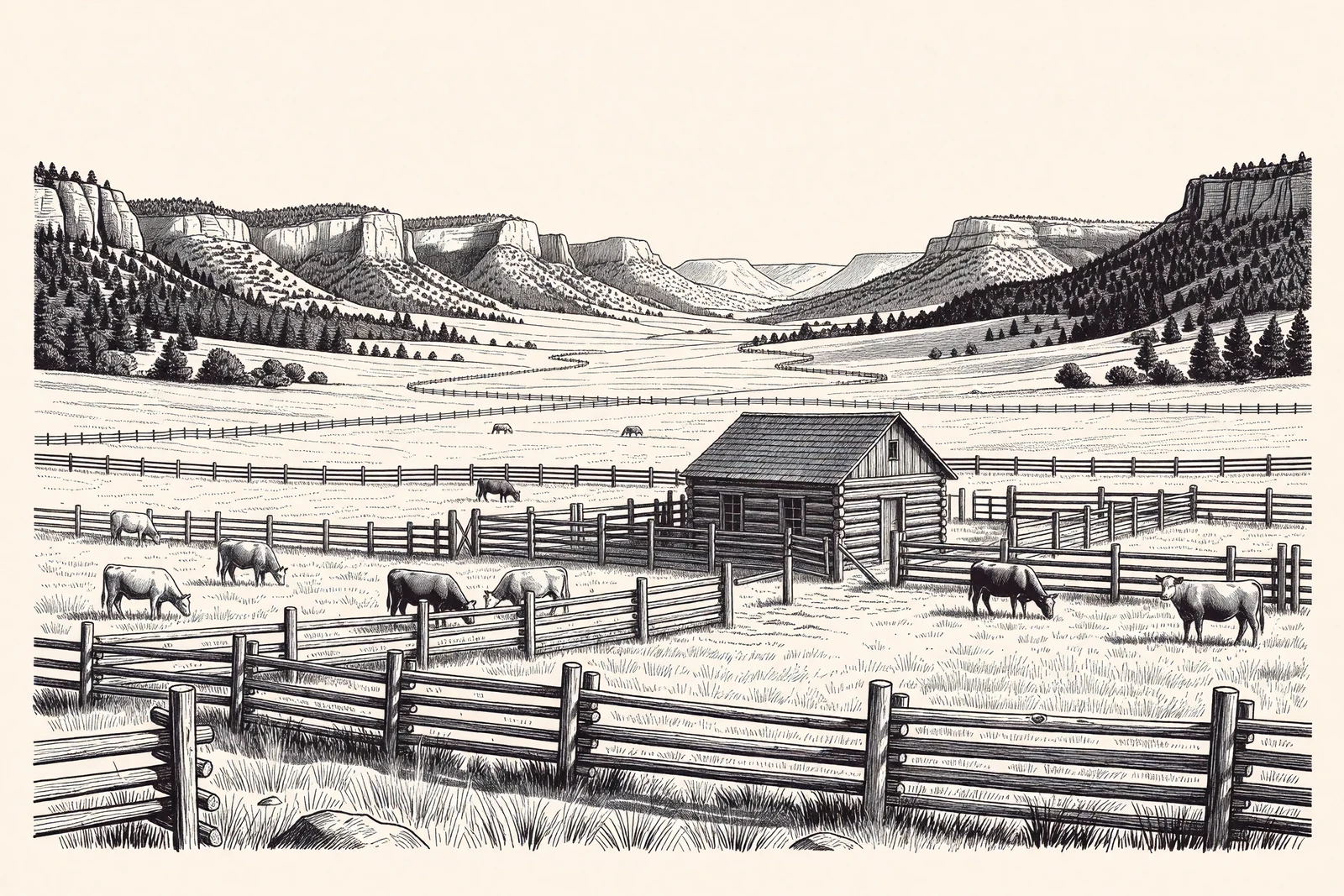
Pleasant Valley is shaped like a large "L." One leg is formed by M O Creek running from west to east while the other leg is formed by Cherry Creek running from north to south. There are mountains on every side with the Sierra Ancha on the south, Crouch Mesa on the east, Naeglin Rim on the north and a whole series of buttes on the west. In the "lap" of the L are the "mesas", now called Waldrip Mesa, where Dad had selected a homestead. The place was one hundred sixty acres in size and was located four or five miles from the store and post office.
We had an immediate reminder of the Pleasant Valley War because there was a grave only a few hundred yards from the site of our future house. It was the grave of a Navajo sheep herder killed by cattlemen in that war. A few years later Floyd and I attempted to dig the body up because we just knew the man was buried with his gun. We worked hard for awhile but stopped when we uncovered some shirt buttons. The grave marker has since been moved for the convenience of Gila County road builders.
Our first order of business on arriving at the "ranch" was that of providing a house. Dad went to work for Bob Bostrom who had a small sawmill on Cherry Creek about three miles from our place. They cut the trees, hauled them to the mill and sawed them into lumber for our house. Meanwhile, we lived in a one room log cabin on the Greer place near our homestead. The dirt floor in the cabin was no problem for the short time we stayed there. Dad and Dalton built a three room house and we moved in to it before winter came in 1920. Grand Dad Bostrom, an elderly gentleman, built a fire place in the new house and we were able to keep reasonably warm even though the fireplace smoked when the wind blew from the west.
We did have neighbors. Buck Joy and family lived a half mile to the southwest. Rufe Russell and family lived on Pine Creek some two miles north and Sonley Clark lived two miles west of us. All of us were home steaders but the Waldrips were the only ones with a permit to run cattle. Just after we finished moving into the house, Dave and Cora Sparks paid us a visit. They drove up in a surrey with a fringe on top pulled by a span of matched bay horses and they officially welcomed us to Pleasant Valley. The Sparks had come from Texas in 1913 so had been in Pleasant Valley for some time before we arrived. They invited us to attend church, told us about the school and made us feel a little less isolated in general.
Later we became acquainted with people who had been active participants in the Pleasant Valley War. The local blacksmith, Henry Blevins, was one of them but neither he nor any of the others were much inclined to talk about the feud. Some others we met were George Wilson, Sam Rose, John Gilland and George Wilson. None of the original leaders of the feud, Grahams and Tewksburys, survived the contest. Zane Gray's book "To The Last Man" had a most appropriate title.
That homestead on the mesa was a "load." I do not know how we survived because there was no reliable source of water. We dug a dirt tank to catch rain water for the cattle and horses. We hauled water from Pine Creek and Cherry Creek for domestic use. Finally we dug a cistern and caught rainwater off the roof of the house but we never had enough to do more than just squeak by. We drilled two wells each three hundred feet deep and when those turned out to be "dry holes" we knew we had to move. After ten tough years we bought a place on Cherry Creek. It was one hundred sixty acres with a large log house, a small log cabin, fences and a well with water in it. The place cost $2,500 and Dad borrowed $1,100 from Theo Spurlock to swing the deal. The very next time we sold cattle we repaid Spurlock but we paid no interest on the loan. Our family did not buy things on credit.
Our life on the mesa was not all bad. There was a great view from our house and if you could forget the lack of adequate water it was a pleasant place to live. Our cattle, which were our only source of income, had great grazing both in winter and in summer and we seldom had to feed any of them. We got enough rain to grow corn, cane, clover, maize and a few melons so we could eat quite well. We also grew pink and pinto beans which were a staple food. There were also plenty of deer, elk and wild turkeys in the area and we had an adequate supply of meat.
Each summer cattle buyers came to look at our herd and to buy the increase. It was necessary to keep the herd at about 100 head of mother cows since we were grazing them on National Forest Land and had a permit for one hundred head.
Once our cattle were sold they had to be driven to a shipping point which was most often at Holbrook but occasionally was at Globe or even Phoenix. The actual point of delivery was at the option of the buyer but was agreed on at the time of sale. We always sold our calves when they were "long yearlings," that is they were animals sold in October and which had been born a year before the previous March. They were roughly eighteen months old. There were always a few cows and a bull or two in the sale herd. Cows that did not produce calves because of age or for any other reason were not kept very long. Bulls were sold periodically to prevent in-breeding.
The distance to the shipping point was eighty to ninety miles and driving a herd that far is no easy task. However, there were corrals spaced one day's drive apart so the herd could be held there over night allowing the cowboys to sleep. Very early in our days in Young, Dad took over the management of the Bar A and the 4 Bar outfit belonging to Miss Ola and Miss Betty Young. They ran about four hundred head so when ours were combined with them there was quite a herd to drive to the railroad.
Preparation for a cattle drive was important and took a great deal of concentration. A cook had to be hired, the chuck wagon greased, work team shod and food and bedding for the crew gathered and packed. The food list always included Teagarden syrup purchased at Frank Bragg's store. There were beans and dried fruit and enough fresh meat for the first two days because meat would not keep without refrigeration more than two days. The fare was mostly beans and dried fruit for the two week trip. The bread of course was dutch oven biscuits and there was Teagarden syrup along with salt pork for breakfast.
A boy was considered mature when he went along on a cattle drive so Floyd and I always wanted to go. School was in session when most drives were held but now and then we were allowed to go along but never at the same time. It was either me or Floyd never both.
The cattle drives went at a very slow pace since the animals would be sold by weight at the railroad we surely did not want to leave a lot of pounds on the trail. They were just grazed along up over the Mogollon Rim, across Canyon Creek and down Black Canyon. From there it was rocky desert all the way to Holbrook. Now and then a herd would make it all the way without a stampede but that was rare. Usually there would be a "run" of some sort every night. The corrals were round in shape so usually the cattle would hit the fence bounce off and just go in a circle until they quieted down. Once in Black Canyon they broke the fence down and scattered all over the area. We spent most of the next day rounding them up but had to drive to the next corral because there were other herds just a day's drive behind us. We also had to repair the corral at Black Canyon for the next herd.
There was pasture for rent at Dry Lake about two days drive out of Holbrook so we usually spent three or four days there letting the cattle gain back any lost weight. As we approached Holbrook we had to cross the Little Colorado River which was full of quick sand. It was a scary experience driving a herd across quick sand which shook like jelly under the weight of the cattle and you had to keep them moving to prevent them from sinking into the sand and getting bogged down. Even crossing the railroad was a problem if a train happened along. The engineers loved to blow live steam in the faces of the cattle just to see them run. It was not a joke for the men who were trying to get the cattle to the stock pens on the other side of the track.
Thousands of cattle were shipped from Holbrook each season and the yards were very busy. Something was always preventing a quick clean access to the pens. Either there were too many cattle or not enough cars or something else would go wrong. When your turn came the cattle were put in the stock pens, then were herded a few at a time through the crowding pens and up a ramp into the cars. It was slow, hard dirty work and when finished everyone was exhausted. When the last animal was loaded, the buyer handed the Boss a check and then it was up to him to take the crew to a steak dinner at the White Cafe in up town Holbrook. I remember very well when were charged one dollar for a steak dinner. Dad thought the price was much too high and told the management so in no uncertain terms. The dinner of course included vegetables, mashed potatoes, bread, pie and coffee as well as a big steak.
The cattle were shipped to the mid-west or to Imperial Valley in California where they were fattened for market. Sometimes a cowboy was hired by the buyer to accompany the cattle on the train. I remember a guy by the name of Troy Speers who went to California with a load of Bar X cattle. Troy's romantic appearance caught the eye of some movie mogul from Hollywood and Troy played some small roles in a few western movies. He came back to the Bar X some time later married to a beautiful Hollywood starlet. They came in her Packard. She lasted almost two weeks at the Bar X and returned to California. Troy had let one get away but he continued to work at the Bar X.