Arizona State Teachers College
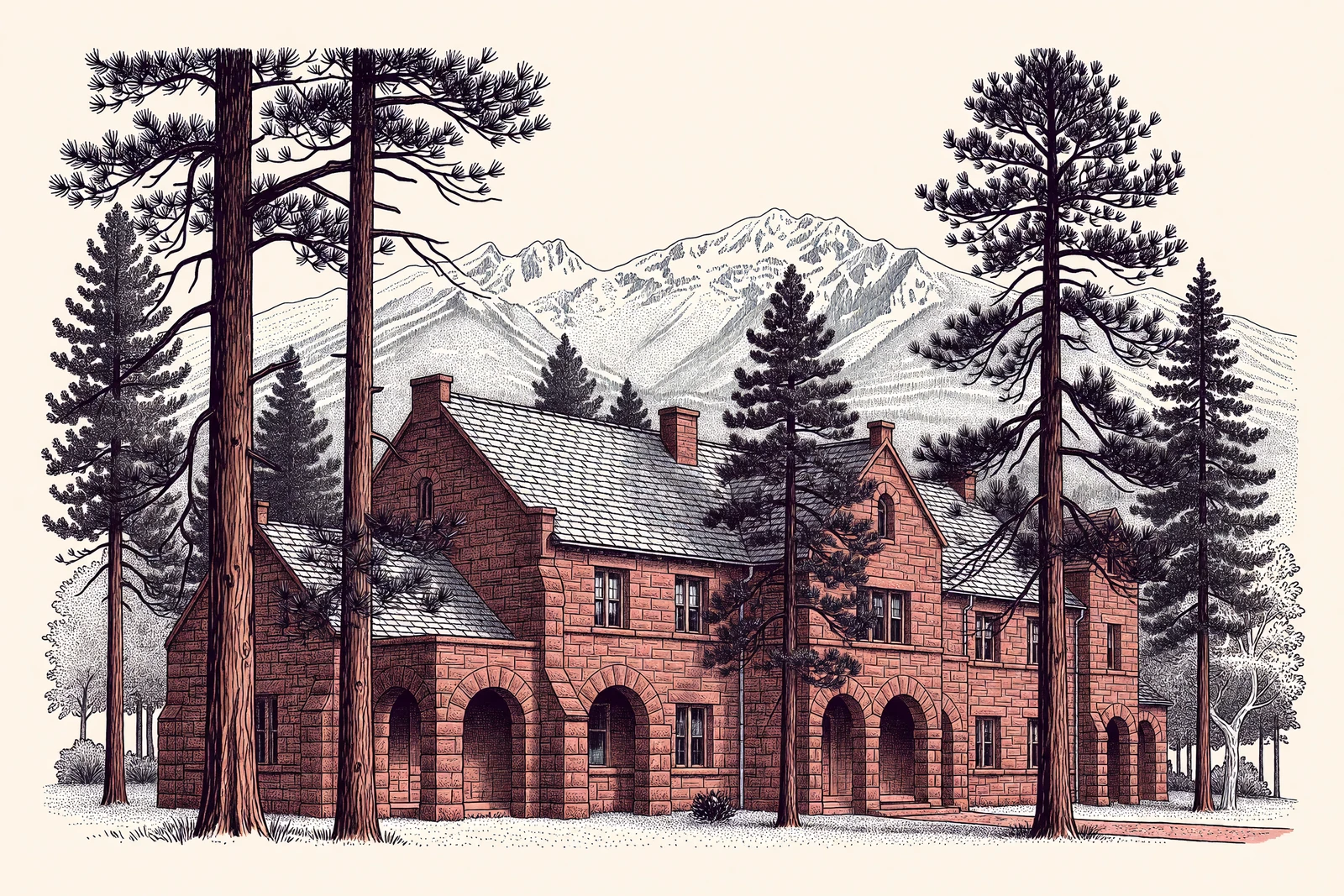
Arizona State Teachers College, now known as Northern Arizona University, was about the size of an average high school when I registered there in 1931. I do not know the exact size but I will guess it was not over five hundred students. I came on campus with over two years of boarding school under my belt so I was quite sophisticated and when they assigned me to the stone cabins south of the campus I arbitrarily moved to Taylor Hall where I found Ray Cordes without a room mate. I moved in and we became good friends. In fact I became well acquainted with Ray's entire family and spent a number of short vacations as a guest in their home. They had a store and post office on the Black Canyon Road south of Mayer. I found that the main source of income for them was the sale of dynamite to mines in the general area. They also sold hay and grain to ranchers.
On the campus, Ray and I were active in the Hiking Club. This was a group that spent almost every Saturday hiking the trails around Flagstaff. Once a year, in May, we went on the "Long Hike" to Havasupai, Betatakin or Rainbow Bridge. This hike lasted a week and only those who had hiked two hundred miles during the year were eligible to go. We carried food, clothing and blankets on our backs and camped out at our destination. This was routine for some of us but was a unique experience for those from a city. The average number on a "Long Hike" was thirty five.
The Hiking Club, under the guidance of Robert Powers faculty sponsor, and with the approval of the U. S. Forest Service, took over a log cabin near Walnut Canyon. The cabin roof was in good shape and we repaired the walls and floors and constructed a fireplace in one corner of the large main room. A perfect sandstone "A" was built into the face of the chimney above the mantle. The "A" of course, was the symbol for Arizona State. Years later after I retired and moved to Arizona I found the remains of the old cabin and there was the "A" perfectly preserved. With the help of the Alumni Association the "A" was moved intact to the north entrance to the campus now known as Northern Arizona University where the current enrollment is some fifteen thousand.
Back to the campus. Since Arizona State was a teachers college and since Aunt Ivel was so idolized, I never considered doing anything other than teaching. I selected education as my major study with minors in social science, english and mathematics. My only academic problem was with mathematics. I got good grades in algebra the first year but the second year was a disaster. The professor was very impatient with all students and especially with those of us who did not learn quickly. I agonized through the first semester and with some tutoring from fellow students I managed to get a passing grade. The second semester was trigonometry which was a snap but I never came close to understanding algebra.
The math professor became ill a short time later and was sent to a mental institution. I think his problem may have stemmed from trying to teach me.
The 1930s was marked and shaped by the great economic depression. Because of that depression nearly every student worked either part time or full time. For the first two years I had a "half time" job. That means I worked for half my board and room. The other half had to be paid in cash. The second two years I distributed the campus mail and that was a "full time" job.
The Registrar of the college, Robert Powers, was responsible for mail service on campus so he picked the person he wanted to perform that service. When Mr. Powers picked me a controversy ensued with the Director of Athletics, Dr. Vaughn Wallace, who wanted an athlete to have the job. College President Tormey settled the argument by ruling that the Registrar was responsible for the mail service so was authorized to choose the carrier. Dr. Wallace was very cool toward me but we never had a confrontation. He ran the Teacher Placement Bureau and he waited until I graduated and found a job in the Verde Valley. When I asked that my confidential papers be sent to the school district, Wallace sent those of another graduate and then sent that person out to be interviewed. That person got the job and I was out. It was a bitter disappointment and I transferred my files to the University of Arizona in Tucson where I had a good friend, Dr. Victor Kelley, who was in charge of Teacher Placement there.
By the end of the winter quarter in 1934 it became evident that I would not be able to finish the school year. The price of cattle was at an all time low so there was little help from my parents. My clothing all needed to be replaced and there was no money to do it with. The only answer was to leave school so I packed up and went back to Young.
I immediately had a talk with the local Forest Ranger, Mr. Pinson. He told me that an experimental crew was being formed and that he would attempt to get a place for me on that crew. This was a group of twenty four men who were to build erosion control dams in Tonto National Forest. The structures were experimental and were to be made from material found in the proximity of the sites. Some were of stone. Others were of wire and stone while others were made from tree limbs weighted down by stones. At any rate I was selected as a crew member and reported to camp at Roosevelt Lake where we constructed some two hundred dams on the south side of the lake before moving to Round Valley near Payson. Later we moved to the East Verde River off Highway 87 and finally to Haigler Creek west of Young.
Most of my job was driving a truck although I trimmed trees, placed rock, fought forest fires and even dynamited stumps that were in a road right of way. On the road job I used a double jack, a four pound hammer, to drive steel drills to make holes for dynamite to blast a road base around a mountain side. Our last job was to complete the Chamberlain Trail which had been started by the CCC gangs but never finished. That road is used today as a short cut between Payson and Young. It is crooked and rough but is passable in dry weather with any kind of vehicle.
The Forest Service crew was disbanded in the winter of 1935 in time for me to return to college in Flagstaff. So exactly one year after leaving school I was back refreshed and refueled ready to finish college.
I was elected President of the Hiking Club for the 1935-36 year and was selected a member of the Chain Gang. This was an honor reserved for "outstanding students" and it was our job to assist and guide underclassmen. We also helped visiting dignitaries and did various chores at athletic events. I still go back to Homecoming Celebrations and visit with today's Cain Gang members.
I was scheduled to graduate in May 1936 but my Advisors had made some bad judgements and I needed a course in English Literature and an Education course in order to graduate. I finally got my A. B Degree in August of 1936. My mother attended the graduation ceremony and was elated that I finally had a degree. I am sure she was disappointed that I had no job but we did not discuss that fact.