Trapping
Earlier in this document I noted the lack of places to get a paying job in Pleasant Valley. The cattle ranchers hired people when they needed help which was mainly in the summer time. So when I came home at Christmas time in 1930 in the dead of winter there was no chance to get a job.
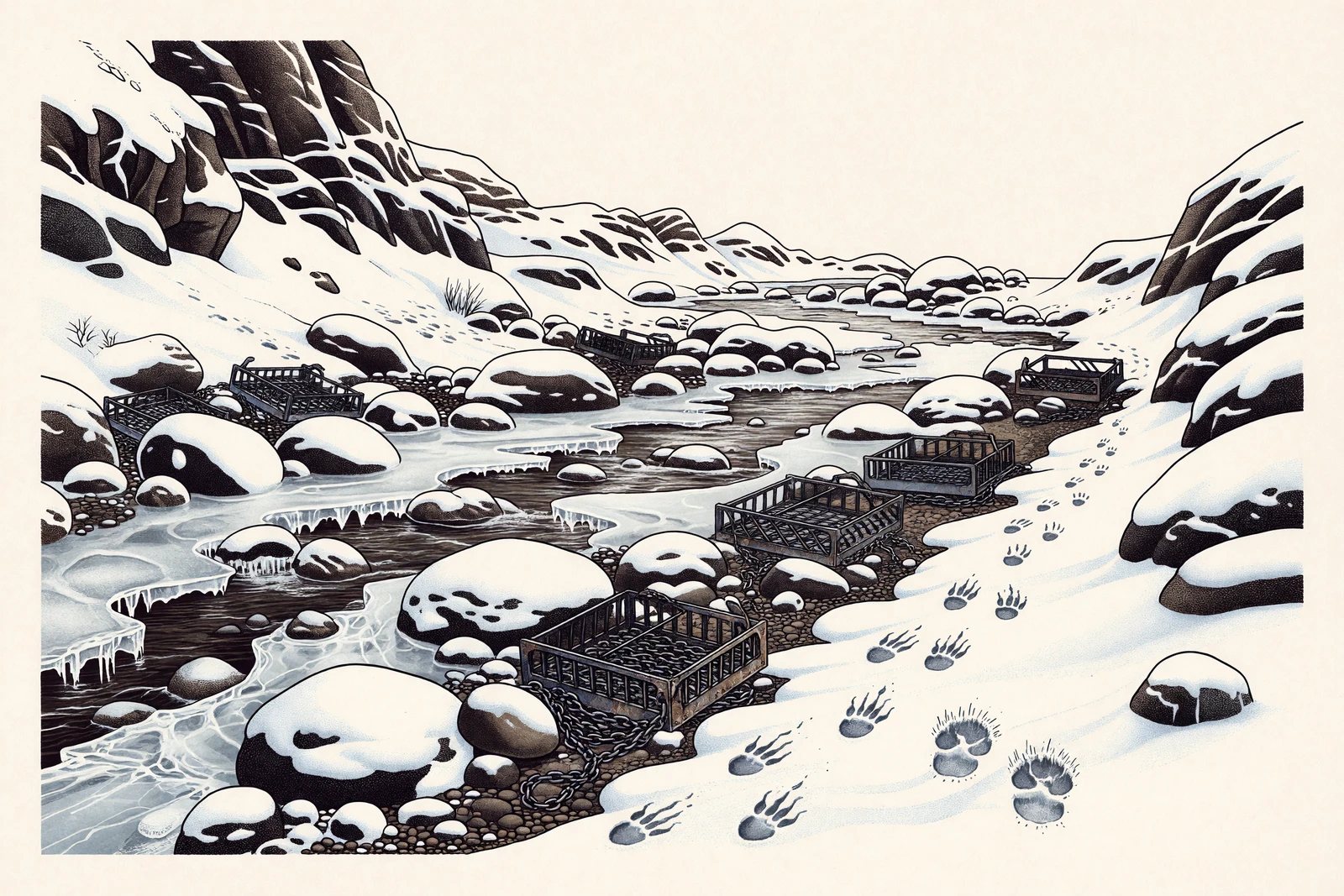
However, there was one thing a person could do to keep busy and to make a little money. That was trapping. Yes, trapping with steel jawed traps. Nearly everyone I knew did a little trapping each winter when the fur was heavy and there was nothing else to do. It required no great skill. You enticed a fox, coyote or raccoon into a trap, killed it and removed the pelt or skin. This was then put on a stretcher composed of two long sticks. The skin was stretched tightly and hung up to dry for a few weeks. It was then taken off and mailed to a fur company, most of which were in St. Louis, Mo. The fur company then mailed you a check. I do not recall exact prices but I think we could get one or two dollars for a fox and three to five dollars for a coyote.
Three of my friends were trapping during the winter of 1930 and they invited me to join them. I was only too glad to accept and brought along a few traps, a horse and a dog. I do not recall how I contributed for the food but I must have helped with the purchase of it. I was able to ride our horse, Tony, on this trip.
We started out in the high country and moved to lower altitude as the snow came. By the end of January we were camped at Blevins Trap on Copper Mountain near the JR Ranch. This was to the north of Roosevelt Lake in the Sierra Ancha Mountains. We had seventy five steel traps out and were averaging seven animals a night. Most of our catch was fox but there was an occasional coyote or a raccoon. Once in awhile we would find a skunk which was almost solid black so we would skin it.
We slept in a small tent and cooked on an open campfire. We turned our horses loose to find whatever food they could and we were glad when they did not stray very far from our camp. Among the horses was Hoggie about whom I have already written. He is the one who sat down off a fifty foot bank and was a victim of loco weed.
The weather was wonderful all through January but early in February it began to rain. We were not terribly uncomfortable since our beds were dry in the tent and we had plenty of fire wood. However, as the rain continued day after day we began to see trouble ahead. We had been out over a month and our food supply was dwindling fast. Venison had been a staple for a long time but the deer were scarce during heavy rain.
One day we were coming back to camp from a trap line and found some fresh deer tracks. Very quickly two of the guys volunteered to trail them and bring in some fresh meat. The other fellow and I continued on to camp where we stretched the new pelts and built a fire in anticipation of having fresh venison for dinner. In a surprisingly short time the two hunters came into camp carrying, not a leg of venison, but two quarters of beef.
Now I don't want to make this story a "True Confession" but we had just stolen a beef. It seems that the two hunters got quite close to the deer they were trailing when the deer suddenly turned straight off the mountain into the Hole in The Ground which is a huge canyon whose bottom is almost on a level with Roosevelt Lake. Just as the deer disappeared, a white faced yearling jumped up out of the bushes and I suppose you can guess the rest.
The players in this drama were Basil Cox, Nelson Turner, Otto Reasoner and yours truly, Sam Waldrip. I don't know if the yearling was branded. I don't know who shot it. I do know the meat tasted very good when we cooked it.
Meanwhile, it was still raining and we were almost out of everything except meat. We hoped the rain would stop but after nearly two weeks decided we were forced to go out for groceries. This meant a twenty mile ride over soft muddy trails and across flooded streams to Young. We first had to find our horses and that took a half day. Our trail led up over a mountain and down a flooded canyon to Buzzard Roost. The horses were weak from lack of good food and the going was slow in the mud. We finally reached Buzzard Roost, where there was a half shelter, at about ten p.m. Fortunately, there was food for our horses and for us. The next day we had to cross Spring Creek and it was in flood. The water was in the tops of the sycamore trees and was really rolling. We went upstream some two miles where we found a place we could get into the water on our side and a place about a quarter of a mile downstream where we could get out on the other side.
Now I knew Tony could swim and Dad had told me to always let the horse decide if he could make it. "Don't force him." Since Tony was the strongest horse in the group I elected to try it first. When Tony's feet left the solid ground we were swept down stream at a terrifying rate of speed. However, Tony knew his business and our crossing was uneventful. Otto Reasoner was the next to cross and he was riding a very small weak pony who turned his head upstream and began to fight the water. He was quickly turned over backward and down the stream came Otto and the horse. I threw a rope to Otto and pulled him out. The horse finally got out on our side just before going into a box canyon. Both Basil and Nelson made good crossings. We were all cold and wet so we built a fire and warmed up a bit before riding on to Young.
We replenished our food supplies and went back to camp where we stayed until sometime in March. When it came time to break camp we found all the horses except Hoggie. After searching for two days we located him. He was sitting under a large juniper tree and was dead. It seemed rather fitting that Hoggie's last move was his "reverse" one. At least he did not sit off a high bank.